AI Content Generation: What Marketers Must Know
Every few years, something changes the economics of content. The jump from print to digital. The rise of search. Social media turning every brand into a publisher. Each shift rewrote who could compete and who got left behind.
AI content generation is one of those shifts, and it is happening right now. Marketing teams that once needed three weeks and a full agency retainer to produce a content calendar are now shipping cluster-level strategies in a single afternoon. Solo founders who could not afford to blog consistently are building topical authority in months. Enterprises that struggled to localise copy across ten markets are doing it in ten languages simultaneously.
But there is also a lot of noise. Vendors selling shortcuts. Teams burning time correcting content that sounds like nobody wrote it. Founders wondering whether Google will penalise them. Marketers unsure whether any of this actually moves rankings, or whether it just fills a CMS with words.
This article cuts through all of that. It explains what AI content generation actually is, how the underlying technology works in plain language, what it can and cannot do for your business, and how to build a workflow around it that produces content that ranks in search engines and surfaces in AI answer engines like ChatGPT, Perplexity, and Google's AI Overviews.
What AI Content Generation Actually Means
Strip away the marketing language and AI content generation is this: software that uses large language models (LLMs) to produce written text, and increasingly images, structured data, and metadata, based on instructions you give it.
Large language models are trained on vast amounts of text. During training, the model learns statistical relationships between words, phrases, ideas, and contexts. When you give the model a prompt such as "write an introduction for an article about email marketing for e-commerce brands," it predicts, token by token, the most contextually appropriate sequence of words to follow. The output is not retrieved from a database. It is generated fresh, drawing on patterns absorbed during training.
The practical result is a system that can produce fluent, structured, contextually relevant prose at a speed no human writer can match. What matters for marketers and founders is not the mechanics behind that. It is what becomes possible when you pair that capability with a structured content strategy.
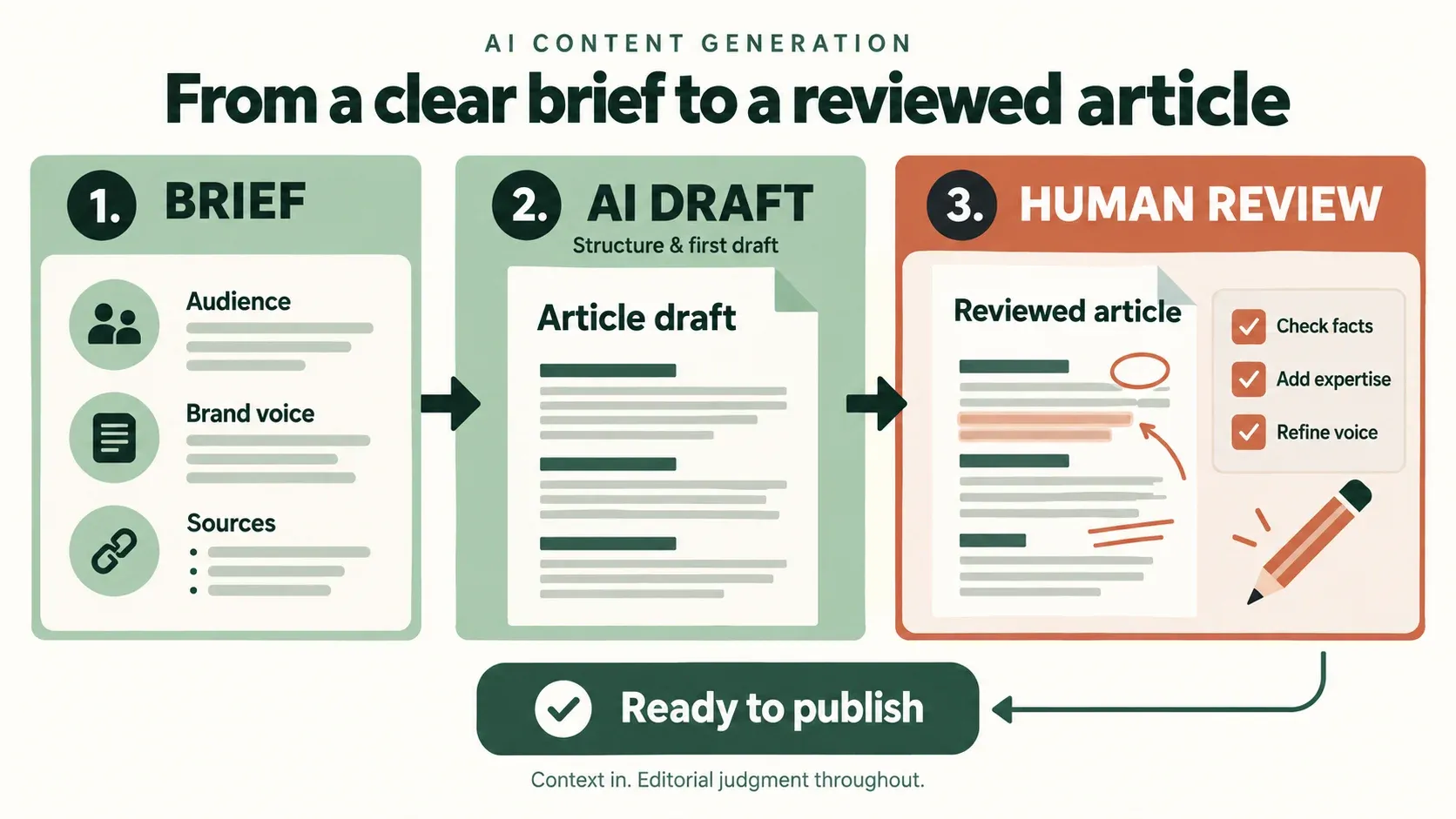
AI content generation is not a replacement for editorial judgement. It is a force multiplier for it. The teams winning with AI are not the ones who use it to skip thinking. They are the ones who think more rigorously about strategy, audience, and brand voice, and then use AI to execute faster and at greater scale.
How the Technology Works Without the PhD
You do not need to understand transformer architecture to use AI content tools effectively. But a surface-level understanding of how these systems work helps you prompt them better and set realistic expectations.
Training and Knowledge Cutoffs
LLMs like those powering modern content platforms are trained on enormous text datasets, including web pages, books, articles, and code, collected up to a specific point in time. This gives the model broad general knowledge but also means it may not know about events or developments after its training cutoff. For most content marketing use cases, such as explaining concepts, writing SEO articles, and creating product descriptions, this is not a significant limitation. For breaking news or highly time-sensitive topics, human editorial input remains essential.
Prompts and Context
The quality of AI-generated content is almost entirely determined by the quality of the instructions it receives. A vague prompt produces vague content. A prompt that includes the target keyword, the intended audience, the desired tone, key points to cover, and relevant context produces something genuinely useful. This is why sophisticated AI content platforms do not just give you a blank box to type in. They structure the prompt construction process, feeding the model everything it needs to produce on-brand, strategically aligned output.
Brand Voice and Fine-Tuning
Out-of-the-box, an LLM writes in a neutral, generalised register. That is useful as a starting point but it is not your brand. The more capable AI content systems let you encode brand voice, including your tone, vocabulary preferences, writing style, and perspective, so that every piece of output reflects how your business actually communicates. This is the difference between AI content that could have come from anyone and AI content that sounds unmistakably like you.
Writegarden's Write feature is built around exactly this principle: brand-voice article generation that stays consistent across every piece, every locale, and every format, without requiring a prompt engineering degree to operate.
What AI Content Generation Can Do for Your Business
The capabilities of modern AI content platforms go well beyond generating a first draft. Here is a realistic picture of what is now possible, and why it matters at different stages of content operations.
Scale Content Production Without Scaling Headcount
The most immediate benefit is throughput. A marketing team of two or three people can now produce the content volume that previously required a much larger team or an ongoing agency engagement. For solo founders and small teams, this is genuinely transformative. It means consistent publishing frequency, faster topical coverage, and the ability to respond to market changes or new keyword opportunities without creating a backlog.
Maintain Strategic Coherence Across a Content Programme
Volume without strategy is noise. The risk with any AI-assisted content programme is producing a large number of articles that do not reinforce each other, articles that compete for the same keywords, leave gaps in topical coverage, or fail to build the kind of thematic authority that search engines and AI answer engines reward.
This is why content operations platforms that integrate research and planning with generation tend to produce better outcomes than standalone AI writers. When your keyword clustering, content brief creation, and article generation all happen in the same environment, informed by the same topical map, the output is coherent by design, not by accident. Writegarden's Research feature maps topic authority from your domain before a single word is written, so that every article you generate is building toward something strategically meaningful.
Produce Multilingual Content at Scale
For businesses with international audiences, translation and localisation have historically been expensive, slow, and difficult to keep consistent with the source brand voice. AI generation removes most of that friction. Producing content natively in multiple languages, rather than just translating English source material, means each locale gets content that reads naturally and is optimised for its own language-specific search behaviour.
Generate On-Brand Imagery Without a Design Team
AI content generation now extends beyond text. AI image generation tools can produce editorial-quality visuals aligned to your brand aesthetic, something that previously required either a stock library subscription, a commissioned photographer, or a design resource. For content-heavy operations, the ability to generate brand-consistent imagery alongside written content removes a significant production bottleneck. Writegarden's Design feature handles this natively, producing brand-consistent AI imagery and correctly formatted alt text as part of the same workflow that produces your written content.
Publish Directly to Your CMS Without Manual Copy-Paste
One of the least glamorous but highest-impact efficiency gains in AI-assisted content operations is eliminating the publish step as a manual task. Modern platforms integrate directly with the CMSs where your content lives, meaning that a finalised article can move from generation to publication without anyone opening a new tab. Writegarden supports all of these through its Publish feature and dedicated integrations, including direct connectors for WordPress, Webflow, Shopify, Wix, and Framer.
The Quality Problem and How to Solve It
The most common objection to AI-generated content is quality. And it is a fair one. If you have ever used a basic AI writing tool and received something that was technically correct but tonally flat, structurally repetitive, and entirely lacking in editorial perspective, you know what poor AI content looks like.
The solution is not to abandon AI generation. It is to understand what causes the quality gap and address it systematically.
Generic Input Produces Generic Output
Most low-quality AI content is the product of under-specified prompts. When you give an AI model a keyword and nothing else, it produces the most statistically average treatment of that topic it can, which is to say, something that sounds like every other article on the subject. Solving this requires giving the model richer input: your specific angle, the audience's actual pain points, the conclusions you want the reader to reach, the tone you want to strike, and the sources or arguments you want incorporated.
No Brand Voice Means No Differentiation
If your AI content platform does not encode your brand voice, everything it produces will default to a neutral, generalised register. This is the most common reason AI content fails to build audience loyalty or brand recognition. It could have been written by anyone. The fix is to invest time upfront defining and encoding your brand voice into the system, then treating that voice specification as a living document that improves over time.
Content Without Structure Does Not Perform in Search
Search engines reward content that is well-structured, covers a topic thoroughly, demonstrates expertise, and earns citations from other authoritative sources. AI generation can produce structure, but it needs to be informed by a real understanding of what the search engine's current top results look like for your target keyword, what related questions users are asking, and how the topic clusters in your domain should connect. This is why the research phase of content operations is not something you should skip, and why platforms that integrate research with generation produce better-performing content than those that treat them as separate processes.
Human Review Remains Non-Negotiable for High-Stakes Content
The appropriate level of human review scales with the stakes of the content. A blog post explaining a general concept can go through a lighter review cycle than a piece making specific technical claims, citing statistics, or representing your brand's official position on a sensitive topic. Building a review workflow that matches review intensity to content risk is how high-volume AI content operations maintain quality without creating a bottleneck.
AI Content Generation and SEO: What You Need to Know
One of the most persistent questions about AI content generation is whether it is safe for SEO. The honest answer requires separating two distinct questions: what search engines officially say about AI content, and what actually drives organic performance.
What Google Actually Says
Google's official position, as stated in its search guidance documentation, is that it does not categorically penalise AI-generated content. What it penalises is content that is low quality, thin, or clearly produced to manipulate rankings rather than to serve users. This means the relevant question is not "was this written by an AI?" but "does this content actually help the reader?" High-quality AI-assisted content that demonstrates genuine expertise, provides real value, and is written for humans rather than search crawlers is treated no differently from high-quality human-written content.
The risk is not AI generation per se. The risk is using AI generation as a substitute for editorial thinking, producing large volumes of thin, repetitive, or generic content and publishing it without human review or strategic alignment.
Topical Authority Is the Real Game
Modern search engine optimisation is less about individual articles optimised for individual keywords and more about building topical authority across a domain. When your site covers a subject thoroughly, across pillar pages, supporting articles, FAQ content, and related subtopics, search engines treat your domain as an authoritative source for that subject area. This is the architecture underlying topic clusters, which Writegarden's blog has explored in depth in its article on topic clusters versus keyword lists.
AI content generation, when deployed strategically, is exceptionally well-suited to building topical authority. It allows you to cover a topic cluster thoroughly and quickly, filling gaps that would have taken months to address manually. The key is that the cluster strategy must come first. Generate content to fill a strategic topical map, not to fill a publishing calendar with whatever seems relevant that week.
Internal Linking, Structure, and Technical Factors Still Matter
AI generation handles the written content. It does not handle internal linking architecture, page speed, structured data markup, or the technical SEO factors that influence crawling and indexation. A well-written AI article sitting inside a poorly structured site will not perform as well as a well-written article inside a site with clean architecture, strong internal linking, and good technical foundations. These elements are complementary, not interchangeable.
AI Content Generation and Answer Engine Optimisation
Search as we knew it is changing. A growing share of information requests, particularly the kind of informational and how-to questions that used to drive significant organic traffic, are now being answered directly by AI systems. ChatGPT, Perplexity, Google's AI Overviews, and similar tools are synthesising content from across the web and presenting answers without requiring users to click through to source pages.
This is not a distant trend. It is happening now, and its impact on organic traffic patterns is measurable. Writegarden's explainer on Answer Engine Optimisation and its overview of the AI engines that now answer your customers' questions go into this shift in detail.
The strategic implication for content operations is significant. Optimising purely for traditional search rankings is no longer sufficient. You also need to optimise for AI answer engine visibility, which means producing content that is structured, authoritative, clearly sourced, and formatted in the way AI systems prefer to extract and cite information.
What AI Answer Engines Look For
AI answer engines tend to favour content that is well-structured with clear headings, that responds to specific questions directly and concisely, that cites credible sources, and that demonstrates genuine topical authority rather than surface-level coverage. Content that is too thin, too vague, or too promotional tends not to surface in AI-generated answers.
This is actually good news for teams building AI content programmes around quality. The factors that help content rank in AI answer engines are broadly the same as the factors that drive strong organic SEO performance: depth, structure, authority, and genuine utility for the reader.
Measuring AI Visibility
One of the challenges of the current environment is that standard analytics tools, which measure clicks, impressions, and rankings in traditional search, do not capture whether your content is surfacing in AI-generated answers. Writegarden addresses this directly through its AI Visibility feature (The Harvest Index), which tracks your brand and content's presence across multiple AI answer engines. Combined with cluster-level performance measurement through Google Search Console integration, this gives marketing teams and founders a complete picture of how their content is performing across both traditional and AI-mediated search.
Building a Practical AI Content Workflow
The difference between teams that get consistent results from AI content generation and those that do not almost always comes down to workflow. Here is what a well-structured AI content workflow looks like in practice.
Step 1: Map Your Topical Territory Before Writing Anything
Before generating a single article, invest time in understanding what topics your domain should own, what gaps currently exist, and how different subtopics relate to each other. This is the cluster research phase. It should be informed by your domain's existing authority, the competitive landscape for your target keywords, and the questions your target audience is actively searching for.
This phase is where most teams underinvest. They skip straight to generation because generation is fast and visible. But content that is not connected to a strategic topical map rarely compounds in the way that cluster-based content does. Writegarden's research on planning content clusters for AEO and SEO simultaneously is a useful starting point for thinking through this architecture.
Step 2: Define and Encode Your Brand Voice
Before you generate content at scale, define what your brand voice actually is. This does not need to be a fifty-page style guide. It needs to answer the key questions: What tone do you write in? What vocabulary do you prefer or avoid? What perspective does your brand bring to its subject matter? What does your best existing content sound like, and what makes it distinctive?
Once you have defined this, encode it into your content generation system so that every piece produced reflects it automatically. This is what separates AI content that builds brand equity from AI content that erodes it.
Step 3: Generate With Structure and Context, Not Just Keywords
When you are ready to generate content, do not start with a bare keyword. Feed the generation process with everything relevant: the target keyword, the intended audience and their level of sophistication, the key arguments or points you want the article to make, the tone and register, the internal links you want to include, and any specific sources or data points worth referencing. The richer the context, the stronger the output.
Step 4: Review, Edit, and Add What Only You Can Add
Review every piece before publication. In this review step, you are not copy-editing for typos. You are adding the things that only you can add: your direct experience, your proprietary data, your specific opinions, your customer stories. These are the elements that differentiate your content from every other AI-assisted article on the same topic and that signal genuine expertise to both readers and search engines.
Step 5: Generate Aligned Imagery and Metadata
Once the written content is finalised, produce the visual and structural elements that support it: the featured image, any supporting visuals, the meta title and description, the alt text for all images, and any structured data markup. With a platform like Writegarden, this is part of the same workflow. The Design feature handles brand-consistent imagery and alt text generation without requiring a separate tool or a separate team member.
Step 6: Publish Directly to Your CMS
Eliminate the manual publish step. With direct CMS integrations, your finalised content, including formatted body text, imagery, metadata, and internal links, can be pushed directly to your live site without any copy-paste. This removes a point of error and removes a step that, at volume, consumes meaningful time.
Step 7: Measure Performance at the Cluster Level, Not Just the Article Level
Track performance by topic cluster, not just by individual article. An individual article might underperform while the cluster it belongs to is building substantial authority. Conversely, if an entire cluster is underperforming, that is a signal about either the topic selection or the content quality that a single-article view would not reveal. Writegarden's Measure feature provides week-over-week cluster-level performance data through Google Search Console integration, giving you the view that actually drives strategic decisions.
AI Content Generation for Different Business Types
The right approach to AI content generation varies depending on your business model, team size, and content objectives. Here is how it tends to play out across the main categories of Writegarden's user base.
Founders and Solo Operators
For a founder running their own content programme without a dedicated marketing team, AI content generation is primarily a leverage tool. It allows you to compete on content quality and volume with organisations that have significantly more resource. The priority for solo operators is usually to establish topical authority in a specific niche quickly, which means focusing cluster research tightly on the most strategically important subject areas and generating content that covers those areas thoroughly rather than spreading thin across too many topics.
The other key priority for founders is brand voice consistency. When you are the brand, every piece of content that goes out under your name needs to sound like you, your perspective, your language, your intellectual approach. Encoding this carefully at the outset of your AI content programme pays dividends across every piece you subsequently produce.
Marketing Teams
For marketing teams, AI content generation typically addresses two problems simultaneously: volume and coordination. Teams that previously struggled to keep up with publishing schedules can now maintain consistent cadence without heroic effort. And teams where content strategy, writing, design, and publishing were handled by different people, with coordination overhead at every handoff, can collapse much of that process into a single integrated workflow.
The strategic priority for marketing teams is usually measurement. Understanding which content is driving results at the cluster level, and being able to allocate AI generation capacity toward the highest-performing or highest-opportunity areas, requires the kind of performance visibility that Writegarden's Measure feature provides. The issue of content fragmentation and its impact on SEO ROI is something teams at scale consistently run into, and cluster-level measurement is the most direct way to address it.
Agencies
For agencies managing content programmes across multiple clients, the operational challenges of AI content generation are different in kind from those facing solo operators or in-house teams. The key requirements are client isolation, which means keeping brand voice, content strategy, and performance data separate across accounts, and the ability to manage workflows at scale without creating coordination overhead that erodes the efficiency gains AI generation provides.
Writegarden's agency workspace is built around these requirements: a multi-tenant environment where each client operates in an isolated workspace, with separate brand voice settings, separate topical maps, and separate performance measurement, all managed from a single agency-level interface.
Enterprises
For enterprise organisations, the considerations expand to include data residency, security compliance, integration with existing marketing technology stacks, and the governance of AI content programmes at scale. The content operations requirements of a business publishing across multiple markets, multiple product lines, and multiple languages simultaneously are significantly more complex than those of a single-market SMB, and the platform infrastructure needs to match that complexity.
Writegarden's enterprise offering addresses these requirements with EU data residency, advanced security compliance, and the operational infrastructure to support content programmes at genuine scale.
Common Mistakes to Avoid
AI content generation is a powerful tool that gets misused surprisingly often. Here are the most common mistakes and what to do instead.
Publishing Without Editorial Review
Generating and publishing content without any human review is the fastest way to undermine the quality and credibility of your content programme. Even a light review that checks for factual accuracy, adds specific examples, and confirms the piece sounds like your brand voice is far better than publishing raw AI output. Build the review step into your workflow as a non-negotiable stage, not an optional extra.
Using AI Generation to Fill a Calendar Rather Than a Strategy
If your content strategy is "publish two articles a week," AI generation makes that easy. But it does not make it meaningful. Content that is not connected to a topical map, that does not build toward cluster-level authority, and that is not informed by real keyword and competitive research rarely compounds over time the way strategic content does. Use the speed AI generation provides to move faster on strategy, not to substitute for having one.
Overlooking AI Answer Engine Visibility
Teams that are optimising exclusively for traditional search rankings are missing a significant and growing portion of the visibility picture. As AI answer engines account for an increasing share of information requests, the content operations teams that will be best positioned are those that are optimising for both, building topical authority that drives organic rankings and structuring content in ways that surface well in AI-generated answers.
Treating Brand Voice as Optional
Generic AI content does not build brand equity. If every piece of content you publish could have been written by any of your competitors, it is not serving your brand. It is just occupying space. The investment in defining and encoding a genuine brand voice is one of the highest-return activities in an AI content programme.
Measuring the Wrong Things
Tracking page views and individual article rankings without understanding cluster-level performance is like tracking individual sales calls without understanding conversion rates. The metrics that drive strategic AI content decisions are cluster-level organic traffic growth, AI visibility, and topical authority coverage, not the vanity metrics that look good in a monthly report but do not tell you where to invest next.
How Writegarden Brings This Together
Most AI content tools solve one part of the problem. A writing tool. An image generator. A CMS integration. A keyword research platform. An analytics dashboard. Each of these, used in isolation, improves on doing nothing, but they create their own coordination overhead, and they cannot share context with each other in a way that produces coherent, strategy-driven output at scale.
Writegarden is built as a unified content operations platform, not a collection of tools bolted together, but a single environment where research, generation, design, publishing, and measurement work together as one workflow. The topical map built in Research informs the brief that drives Write. The brand voice encoded in Write informs the visual aesthetic applied in Design. The content published through the CMS integrations is measured at the cluster level through Measure. The AI Visibility feature closes the loop by tracking how all of that content is performing not just in traditional search but in the AI answer engines that are increasingly mediating how your audience finds information.
The platform is built for the three types of operator who most need this kind of integrated infrastructure: founders and solo operators who need leverage, marketing teams who need coordination and measurement, and agencies who need scale with client isolation.
Pricing is straightforward: one plan, every feature, every engine, at €49 per month. No feature tiers. No per-seat overhead that makes scaling expensive. No reason to leave parts of the platform unused because they are gated behind a more expensive plan.
The Bigger Picture
AI content generation is not a shortcut to good content. It is a structural shift in what is possible for teams and individuals who approach it with genuine strategic intent.
The economics of content production have changed permanently. The cost of producing a well-structured, brand-voice-consistent article that covers a topic cluster thoroughly is now a fraction of what it was three years ago. That does not mean quality is easy. It means that quality is now a function of strategic thinking and editorial judgement rather than production budget. The teams that understand this are building content programmes that were previously only accessible to the largest organisations.
At the same time, the destination for that content is changing. Search engines are evolving. AI answer engines are growing. The content that will compound in value over the next several years is content built for both, content that ranks in organic search, surfaces in AI-generated answers, builds genuine topical authority, and is produced consistently within a brand voice that makes it recognisably yours.
That is the content programme worth building. AI content generation, used thoughtfully and within an integrated operations platform, is what makes building it possible.
This article was generated with the assistance of artificial intelligence.