The Future of Keyword Research: How AI Is Revolutionizing SEO Strategy in 2024
How is AI reshaping keyword research in 2026?
Keyword research is the practice of identifying and weighing the search terms people type or speak into search engines so a business can build content around real demand. In 2026, artificial intelligence is reshaping every stage of that practice, from estimating search volume to labeling intent and grouping topics, turning what was once a spreadsheet exercise into a data-rich, semantic system that also accounts for AI response engines and generative overviews.
Consider a mid-size operator: Northfield Analytics, a B2B software company selling demand-forecasting tools to mid-market retailers. The team ranks for 340 keywords and pulls roughly 28,400 organic sessions a month, but its content has stalled because every new page is built one term at a time. When Northfield's marketing lead switches to an AI-assisted process, the first output is a list of 1,200 candidate search phrases around "inventory optimization" and "demand forecasting," grouped by topic and intent in under an hour instead of the two weeks the old manual process required.
Machine-learning-driven volume analysis
Machine-learning models now estimate search demand by combining several data streams instead of a single ad-platform export, producing sharper volume figures than older tools that relied on one narrow source. DataForSEO's Keyword Data API pulls from a database of more than two billion keywords enriched with pay-per-click metrics, letting teams check up to a thousand terms in one request and surface phrases that never appear inside a standard ad account.
For Northfield, this matters because several of its 1,200 candidate phrases showed no data in older tools but appeared with real volume once cross-referenced against this larger dataset, a gap that would have hidden genuine demand under the old method.
Automated trend detection
Automated trend detection tracks how phrase popularity moves over time and location, replacing the static, once-a-quarter review that older workflows depended on. DataForSEO's Trends API scores relative interest on a 0–100 scale across more than 170 locations, with demographic breakdowns by age, gender, and subregion, so a rising phrase can be spotted before competitors notice it.
A separate Phrase Trends endpoint tracks how often a term is cited across web content by date range, showing whether usage is climbing in titles, snippets, or full body copy, a level of granularity manual spreadsheets never offered.
Semantic intent insights
Semantic intent analysis is the classification of what a searcher wants to accomplish (informational, commercial, transactional, or navigational) using language patterns and search-results features rather than guesswork. According to DesignCopy, AI-powered classifiers now label intent with 85–92% accuracy across thousands of terms in seconds, drawing on search-results feature analysis, linguistic pattern matching, and click-behavior modeling.
That level of accuracy is what lets a small team like Northfield's sort 1,200 phrases into content-ready groups without a week of manual review, freeing analysts to focus on the strategic calls a model cannot make on its own.
What limitations exist in traditional keyword research methods?
Ad-platform volume ranges, single-number difficulty scores, and hand-checked results pages define traditional keyword research, a system that lags behind real search behavior, creates clustering bottlenecks at scale, and tempts teams toward repetitive, single-phrase optimization that AI response engines increasingly deprioritize.
Reliance on outdated volume estimates
Volume figures pulled from ad platforms are often rounded into bands, updated slowly, and shaped by advertiser bidding rather than raw searcher behavior. Practitioners working with AI-assisted pipelines are told to treat every model-generated phrase as a hypothesis and confirm it against live keyword databases and trend tools before trusting it, according to AI Marketing Tool.
Northfield's team learned this the hard way: three of its highest-priority phrases showed strong historical volume but flat or declining trend lines once checked against current data, meaning the pages it planned to build would have targeted a shrinking audience.
Manual clustering bottlenecks
Manual clustering asks a person to read a list of terms and decide, one by one, which belong on the same page, a process that breaks down once the list passes a few hundred entries. Timothe's ten-step framework for AI keyword research treats clustering by topic and intent as its own dedicated step, separate from volume validation, because grouping by hand at scale is where most teams stall.
With 1,200 candidate phrases, Northfield's marketer could not have grouped them manually in any reasonable timeframe; automated clustering compressed that step into an afternoon.
Risks of keyword stuffing
Keyword stuffing is the outdated practice of repeating one target phrase across headings and body copy in hopes of ranking for it, and it actively works against how modern search systems read content today. Topic-cluster research from Floyi and Search Engine Land both point out that AI response systems reward pages covering a subject with varied phrasing, related entities, and clear subheadings, not phrases repeated for density.
DimensionTraditional approachAI-driven approachVolume dataSingle ad-platform export, updated slowlyMulti-source models, updated with trend scoringClusteringManual grouping, limited to small listsAutomated topic and intent grouping at scaleIntent labelingAnalyst judgment, term by termClassifiers with 85–92% labeling accuracyContent strategyOne page per phrase, repetition-heavyThematic hubs with varied, entity-rich language
How can voice and conversational search reshape keyword discovery?
Voice and conversational search push people toward full sentences and multi-word questions instead of short, clipped phrases, which means keyword research now has to model long-tail, natural-language search text alongside classic short-tail terms. Mining sources such as People-Also-Asked panels, forum threads, and AI-generated variations captures this spoken-language pattern more reliably than volume-only tools ever did.
Natural-language search phrasing patterns
Natural-language search phrasing includes full sentences, multi-clause requests, and conversational qualifiers that rarely appear in short-tail keyword lists. Topic-cluster research from Floyi recommends mining People-Also-Asked data, AnswerThePublic, Reddit, and niche forums to understand how a market actually talks about a subject in everyday language, according to Floyi.
Long-tail phrase modeling for spoken search
Long-tail phrase modeling uses AI assistants to generate realistic spoken-style search text, phrases like "best demand-forecasting software for a 50-person retail team," which are then checked against real trend and volume data rather than trusted outright. Timothe's framework specifically instructs teams not to invent metrics when prompting a model, only to generate candidate phrasing that gets validated afterward.
For Northfield, this step surfaced dozens of natural-language variants around "how to forecast inventory for seasonal demand" that never showed up in short-tail keyword lists but matched real informational searches once cross-checked in Search Console.
Optimizing content for spoken search
Optimizing for spoken search means writing subheadings that mirror how people phrase a request out loud, then leading each section with a direct, self-contained response before adding detail. Search Engine Land's outline for building topic hubs for AI response engines notes that each content section should open with a subheading matching real search phrasing and stay focused on one subject so a system can lift and cite it cleanly, according to Search Engine Land.
How do semantic search and entity analysis improve keyword relevance?
Semantic search and entity analysis improve relevance by mapping the people, products, and concepts connected to a topic rather than treating each phrase as an isolated string. This lets a content plan cover the full subject a search or AI system expects, instead of one narrow slice of it.
Topic modeling techniques
Topic modeling groups related search phrases into shared themes based on meaning rather than exact wording, so "demand forecasting," "inventory planning," and "stock-out prevention" land in the same content hub instead of three disconnected pages. Decipher's outline on building topic hubs for AI search stresses that this kind of grouping signals depth and expertise to systems that read a site as a map, according to Decipher.
Entity extraction processes
Entity extraction is the identification of named things, brands, products, locations, roles, inside search text and content, letting a strategy build coverage around a core subject and the entities tied to it. InsideA's breakdown of topic clusters for answer-engine optimization describes layered entity mapping, where a core subject is surrounded by adjacent subjects and intent layers, according to InsideA.
Using co-occurrence data
Co-occurrence data shows which phrases and entities appear together across content, revealing the modifiers and adjacent subjects a market expects near a core topic. RankMax's material on topic clusters points out that this pattern data helps teams spot subtopics they would otherwise miss by reading a single keyword list top to bottom, according to RankMax.
Which AI-powered tools streamline keyword research workflows?
AI-powered tools now handle the repetitive parts of keyword research, including batch intent labeling, trend pulling, and topic grouping, in minutes rather than days, letting a marketing team spend its time on strategy and content quality instead of spreadsheet cleanup.
Writegarden's cluster research integration
Writegarden is an AI-native content operations platform that maps topic authority from a brand's own domain, then carries that research straight into brand-voice drafting, imagery, multi-platform publishing, and AI visibility tracking within one workspace. Rather than exporting a keyword list into one tool, briefs into another, and drafts into a third, a team like Northfield's can move from a 1,200-term research pass to a structured cluster plan and, through AI content generation, into publish-ready drafts without re-keying the research at every handoff.
Automated suggestion engines
Automated suggestion engines classify batches of search phrases into intent categories, funnel stages, and recommended content formats in one pass. Grigora's classifier accepts up to 200 phrases at a time and exports labeled results to a spreadsheet, according to Grigora, while ToolMint's version adds secondary intent, a suggested call-to-action, and a confidence score per term, according to ToolMint.
API-based search trend monitoring
API-based trend monitoring pulls live popularity and volume data programmatically instead of through one-off manual exports, which matters for teams tracking hundreds of clusters at once. DataForSEO's Trends API supports up to five phrases per request across Google Search, News, and Shopping surfaces, according to DataForSEO, giving Northfield's team a repeatable check on which of its 1,200 candidate phrases are gaining or losing traction month over month.
How do you integrate keyword intent classification into research?
Intent classification sorts every search phrase by what the searcher actually wants, whether information, comparison, or a purchase, and feeds that label directly into which page type, format, and call-to-action a team builds next. Skipping this step is a common reason keyword lists produce content that ranks but never converts.
Distinguishing informational vs transactional intent
Informational intent describes searches where someone wants to learn something, while transactional intent describes searches where someone is ready to buy or sign up; the two require different page types entirely. Floyi's classifier adds generative and branded categories on top of these, mapping each phrase to a buyer-journey stage such as awareness, consideration, or decision, according to Floyi.
Automated intent scoring
Automated intent scoring assigns a confidence percentage to each label so a team knows which classifications need a manual second look. RankSpot's free checker returns an intent label, a confidence score, and a short explanation for each phrase, according to RankSpot, which is exactly the kind of check Northfield's team ran on its highest-priority terms before building pages.
Mapping content formats to intent
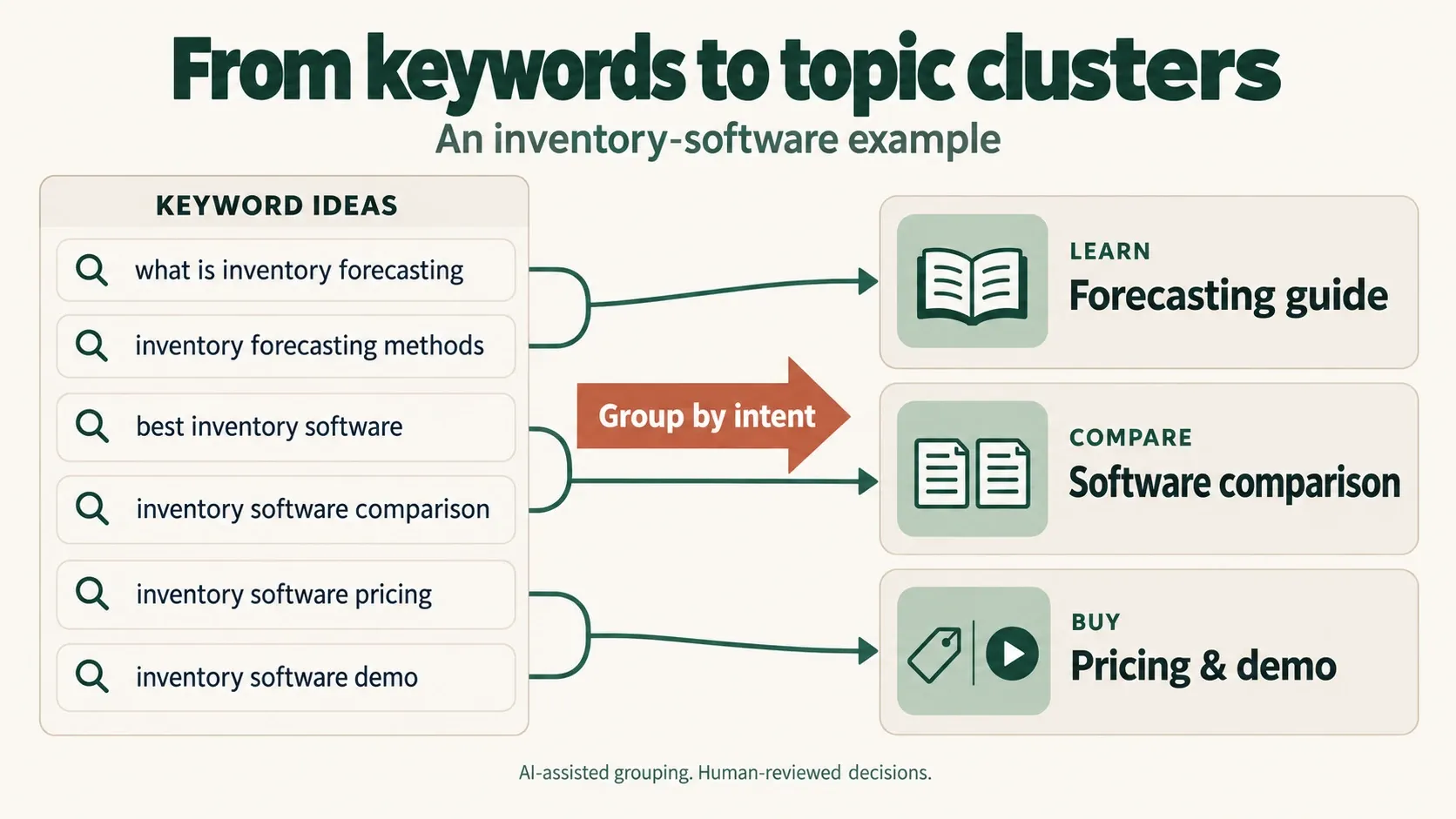
Mapping formats to intent means pairing informational phrases with blog or explainer content, comparison phrases with side-by-side pages, and transactional phrases with product or pricing pages. SEOPlugin's intent detector recommends a content format alongside every label it returns, according to SEOPlugin, removing the guesswork from a step that used to depend entirely on analyst experience.
How can topic clusters boost SEO beyond individual keywords?
A topic cluster is a group of pages built around one core subject, with a central hub page and supporting pages that each address a specific piece of the broader question, all linked together. Clusters outperform single-keyword pages because they demonstrate depth on a subject to both classic search engines and AI response systems, which now favor sites that cover a topic from multiple angles.
Building thematic content hubs
A thematic hub organizes a core subject page alongside supporting pages that each target a related search phrase or intent, rather than scattering that coverage across unconnected posts. AI-Led Growth's five-stage framework treats clustering and scoring as distinct steps precisely so that a finished plan produces a hub, not a pile of disconnected articles, according to AI-Led Growth.
Northfield turned its 1,200 validated phrases into six hubs, including demand forecasting, inventory optimization, and stock-out prevention, each anchored by one pillar page and eight to twelve supporting pages, then used AI content generation to draft the first pass of every page in brand voice before human editing.
Strategic internal linking
Strategic internal linking connects every supporting page back to its pillar and sideways to related supporting pages, signaling topical depth to search systems and helping readers move naturally between related subjects. Search Engine Land notes that this kind of internal network is a core factor in whether an AI response engine treats a site as an authority worth citing on a subject, according to Search Engine Land.
Tracking cluster performance metrics
Tracking cluster performance means measuring rankings, clicks, and visibility at the hub level rather than checking one keyword at a time, since a hub's value shows up in aggregate traffic and citation frequency across dozens of related pages. This is where week-over-week measurement tied to search console data and AI visibility tracking becomes more useful than a single-keyword rank check, letting a team see whether an entire subject area is gaining ground rather than watching isolated phrases bounce around.
What emerging trends will shape the future of keyword research?
The next phase of keyword research is predictive rather than reactive: models will forecast which topics are about to gain demand, generative search outputs will need direct citation-worthy passages rather than ranked links, and cross-locale data will matter as much as language translation for global content plans.
Predictive intent forecasting
Predictive intent forecasting uses trend trajectories and demographic data to flag which search phrases are likely to gain demand before volume tools show a spike. DataForSEO's Trends API already scores relative popularity across 170-plus locations with demographic breakdowns, according to DataForSEO, and that same infrastructure is the foundation predictive models will build on to flag rising subjects weeks ahead of a competitor's manual review cycle.
Generative search engine outputs
Generative search outputs are the AI-written summaries that now appear above classic results, and they change what "ranking" even means since a summary can fully satisfy a search without a click. Practitioners tracking AI keyword workflows now treat checking whether a generative summary already covers a phrase's informational need as a mandatory step before investing content resources in it, according to AI Marketing Tool.
Cross-locale AI insights
Cross-locale insight means understanding how the same subject is searched differently across countries and regions, not simply translating one keyword list into another language. DataForSEO's Trends coverage across more than 170 locations, with subregion-level interest data, according to DataForSEO, gives multi-market teams a way to spot where demand for a subject like inventory forecasting looks different in, say, Germany versus Southeast Asia, rather than assuming one plan fits every market.
What readers often want to know about keyword research
Is keyword research still necessary now that AI response engines summarize results directly?
Yes, keyword research is still necessary because AI response engines still need to identify which sites to pull from, and that selection is driven by topic depth, entity coverage, and search-phrase relevance. According to Search Engine Land, sites organized into clear topic hubs are more likely to be cited by generative summaries than pages built around one isolated phrase.
How many search phrases should a small team research before building content?
A workable starting range is 200 to 1,500 validated search phrases per subject area, grouped into six to ten topic hubs rather than treated as individual pages. Northfield's 1,200-phrase research pass, split into six hubs, reflects a scale that a two-person marketing team can realistically research, cluster, and publish within a single quarter.
What is the difference between keyword clustering and keyword grouping by hand?
Manual grouping relies on an analyst's judgment about which phrases look similar, while automated clustering uses shared search-results data or intent labels to group phrases by demonstrated behavior. Floyi's clustering feature, for instance, groups terms by shared search results rather than by surface-level wording, producing groupings closer to how a search or AI system actually interprets the subject.
Do long-tail phrases still matter if voice search keeps growing?
Long-tail phrases matter more, not less, as spoken and conversational search grows, since voice queries are naturally longer and more specific than typed short-tail terms. Mining sources such as People-Also-Asked panels and AI-generated phrasing variants, then validating them against trend data, is the most reliable way to build a long-tail list that reflects how people actually speak a search request.
How often should a keyword research plan be refreshed?
A quarterly refresh is a reasonable baseline for most subject areas, with a lighter monthly check on trend direction for fast-moving topics. Because AI response summaries and generative outputs change what a top-ranking result even looks like, a plan that goes untouched for a year risks targeting search phrases whose click behavior has already shifted underneath it.
Sources
- https://www.grigora.co/tools/keyword-intent-classifier/
- https://www.tool-mint.com/tools/ai-keyword-intent-classifier
- https://floyi.com/tools/keyword-intent-classifier/
- https://designcopy.net/en/ai-search-intent-analysis/
- https://www.rankspot.ai/free-tools/keyword-intent-checker
- https://www.aiocopilot.com/tools/search-intent-classifier
- https://seoplugin.ai/tools/keyword-intent-detector/
- https://floyi.com/blog/topic-cluster-strategy-seo-ai-search/
- https://searchengineland.com/guide/topic-clusters-for-ai-search
- https://www.rankmax.com.au/articles/topic-cluster
- https://insidea.com/blog/seo/aeo/topic-clusters-aeo
- https://www.decipher.agency/guides/topic-clusters-ai-search
- https://docs.dataforseo.com/v3/content_analysis-phrase_trends-live/
- https://dataforseo.com/apis
- https://dataforseo.com/apis/dataforseo-trends-api
- https://docs.dataforseo.com/v3/keywords_data-google_trends-overview/
- https://ai-marketing-tool.com/blog/keyword-research-with-ai/
- https://timothe.ai/blog/seo/ai-keyword-research-workflows
- https://ailedgrowth.com/learn/ai-keyword-research-workflow
This article was generated with the assistance of artificial intelligence.