Topic Clusters vs Keyword Lists: Build a Useful Page Map




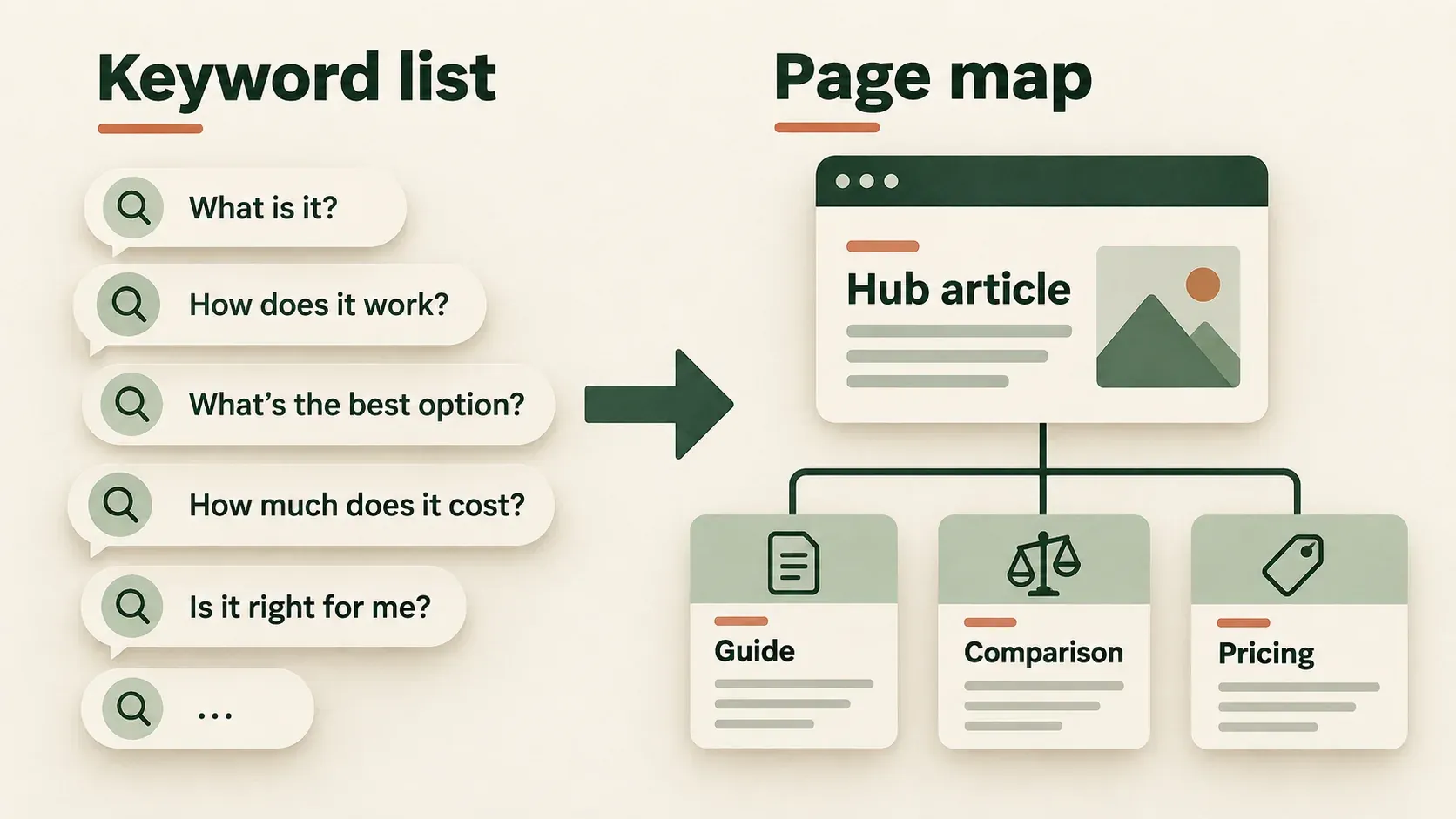
A keyword list is a record of search language: phrases people type, arranged by theme. A topic cluster is a different kind of document. It assigns each question or phrase to a specific page, states what evidence that page needs to answer the question properly, and defines how the page connects to the next step a reader might take. The practical difference is ownership. A keyword list tells you what people ask. A cluster plan tells you which page answers each question, who is responsible for keeping that answer accurate, and where the reader goes next.
This distinction matters because a spreadsheet of phrases grouped by "topic" often hides three separate problems: duplicate pages competing for the same reader, pages that answer a question only partially, and links that exist because two articles share a keyword rather than because one page genuinely helps the reader finish the other page's task. A page map makes these problems visible so an editor can address each one.
A worked example: inventory planning
The following is a fictional planning exercise for an inventory-software website, not measured search data or a customer result. The phrases illustrate how to make editorial decisions; they do not assert search volume or difficulty.
| Question or phrase | Reader's decision | Intended page | Evidence needed |
|---|---|---|---|
| Inventory forecasting | Understand the process | A forecasting guide | An explained method and reviewed example |
| How to calculate a reorder point | Perform a task | A calculation walkthrough | Formula inputs, units and limitations |
| Inventory software comparison | Compare alternatives | A comparison page | Verified capabilities and evaluation criteria |
| Inventory software pricing | Assess purchase fit | The actual pricing page | Current prices, limits and billing terms |
These four pages are related, but no reader should have to visit all of them to finish one task. Each page must stand on its own and answer its own question completely. The forecasting guide should not force someone who just wants the reorder-point formula to read a full explanation of demand modelling first. Equally, the comparison page should not repeat the pricing page's numbers from memory; it should link to the pricing page when total cost becomes relevant to the comparison.
The connections between pages matter as much as the pages themselves. The forecasting guide can link to the calculation walkthrough at the point where it introduces replenishment. The comparison page can link to current pricing when it discusses total cost of ownership. Neither link is decorative; each exists because the reader has reached a point where the destination page answers the next question they are likely to have.
Decide when two phrases need one page
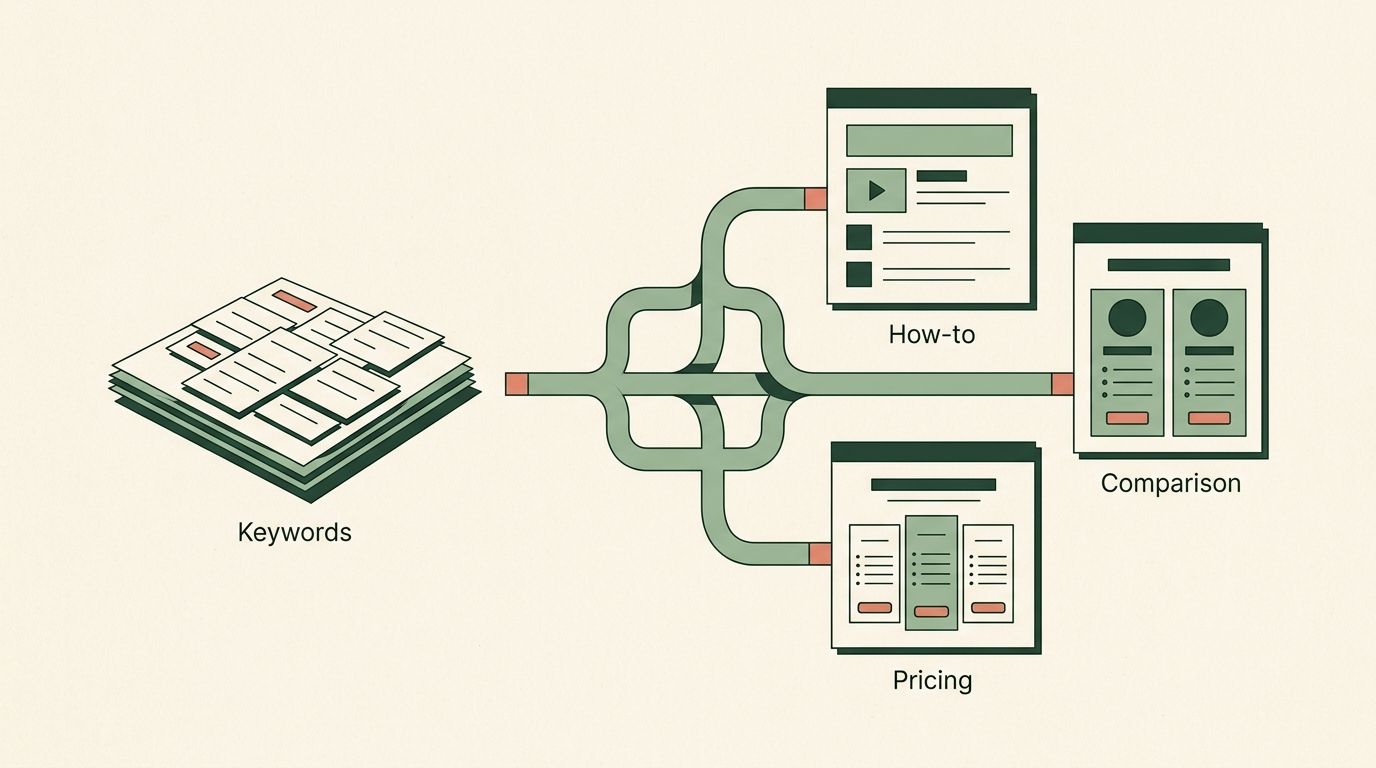
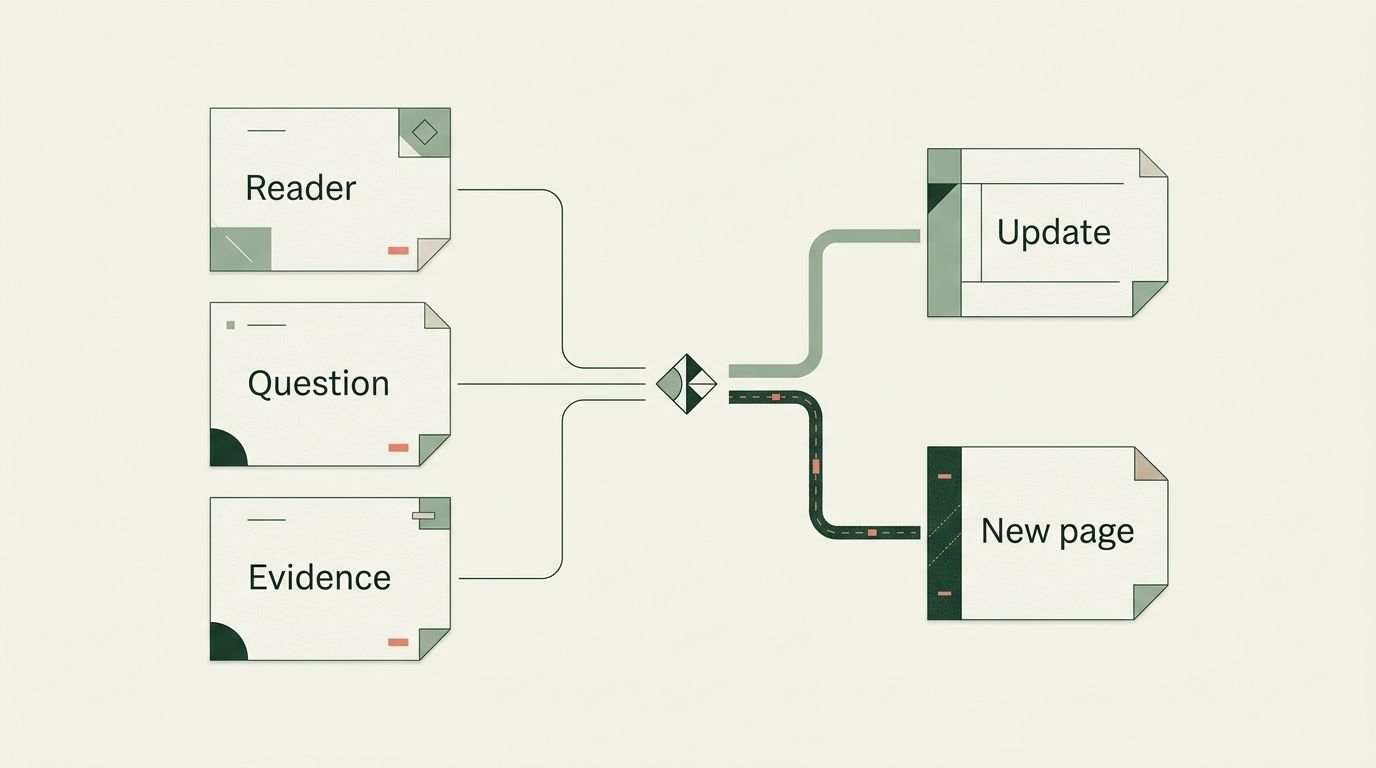
Before creating a new URL for a new phrase, run a short comparison against your existing content: the reader, the question, the answer, and the evidence available. If the new phrase leads to the same answer for the same person, do not build a second page. Expand or improve the page that already exists. A second page answering an identical question adds another page to maintain and risks inconsistent answers if one page is updated while the other is forgotten.
If the new phrase requires a genuinely different decision, or needs a substantively different method or evidence set, then a separate page is likely to be useful. "How to calculate a reorder point" and "how to calculate safety stock" might look similar in a keyword tool but lead to different formulas, different inputs, and different reader actions; treating them as one page would either bloat the page or shortchange one of the two calculations.
Record the merge decision in the plan itself, in plain language: "These phrases share the same calculation and audience, so one walkthrough owns both." A sentence like this is more useful to an editor during a later review than a cluster label with no explanation attached. Tools that suggest keyword groupings, including AI-assisted ones, can be a starting point, but an editor should still examine the ambiguous cases directly, and should check the actual search results for the market in question rather than relying solely on a grouping suggestion.
Common mistakes when building a page map
A few patterns recur often enough to be worth checking for directly before publishing:
Treating a keyword cluster as a publishing target. If the plan says "publish twelve pages for this cluster," the twelve pages tend to get written regardless of whether twelve distinct reader decisions actually exist. Start from the decisions, not from the phrase count.
Linking on keyword match rather than reader need. Two articles that both mention "reorder point" are not automatically useful to link together. The link should exist because the reader, at that point in the first article, needs the second article to continue.
Letting the pricing page drift from the comparison page. When a comparison page states prices directly instead of linking to the pricing page, the two pages can quietly disagree after the next price change. Link to the actual pricing page rather than repeating figures.
Skipping the merge check. Adding a new page for every new phrase, without first asking whether an existing page already answers it, can produce overlapping pages that are harder to maintain.
Writing vague anchor text. "Learn more" or "read this" gives the reader no reason to click and no idea what they will find. Anchor text should describe the destination.
Build links that explain the next step
Use descriptive link text at the exact point where the supporting page becomes useful, not in a generic list at the end of the article. A navigation grid of related links cannot substitute for a contextual explanation placed where the reader actually needs it. Google's own link guidance recommends crawlable links and anchor text that helps explain what the destination page contains.
Avoid adding a link merely because two articles happen to contain the same keyword. Returning to the forecasting example: "check the reorder-point calculation" gives the reader a clear destination and a clear reason to go there. "Learn more" does not; it forces the reader to guess what they will find and whether it is worth the click.
Maintain a page map, not a publishing quota
For every planned page, record the stable URL, the reader decision it serves, the responsible reviewer, the evidence source behind its claims, the supporting links it contains or receives, and the next review date. Add an explicit outcome field, such as a relevant enquiry or a trial activation, but leave that field unmeasured until suitable data actually exists to fill it. A page map with an empty outcome column is more honest than one with a guessed number in it.
After publication, check two things separately. First, whether the intended URL receives relevant search impressions for the question it was built to answer. Second, whether readers who land on that page actually reach the useful next step, whether that is the calculation walkthrough, the comparison page, or the pricing page. Search Console data can reveal overlap between pages competing for the same query, but a change in impressions on its own does not prove that a clustering change caused it; other changes to the site, to competitors, or to the search results themselves can produce the same pattern. Keep dates and any other changes made around the same time in the review record, so that later analysis has something to compare against.
Set a genuine review date for each page rather than leaving the field blank. A calculation walkthrough with formula inputs and limitations should be checked whenever the underlying method changes. A pricing page should be checked whenever prices, limits, or billing terms change, since that page is often linked to from several other pages that quietly depend on it being current.
Putting the map into practice
The value of a page map over a keyword list is not that it looks more organised. It is that it forces two decisions to be made explicitly, before publication, that a keyword list allows an editor to skip: whether this phrase truly needs a new page, and where exactly the reader should go once this page has answered its part of the question. Both decisions are cheap to make on paper and expensive to fix after several pages have already been published without them.
The AI-assisted keyword research guide covers how to validate the inputs that feed into this kind of planning. The agency planning workflow shows how to keep a page map like this separate and current for each client, rather than letting several clients' plans blur into one shared spreadsheet.