What Is AEO? A Practical Content Brief for Answer Engines




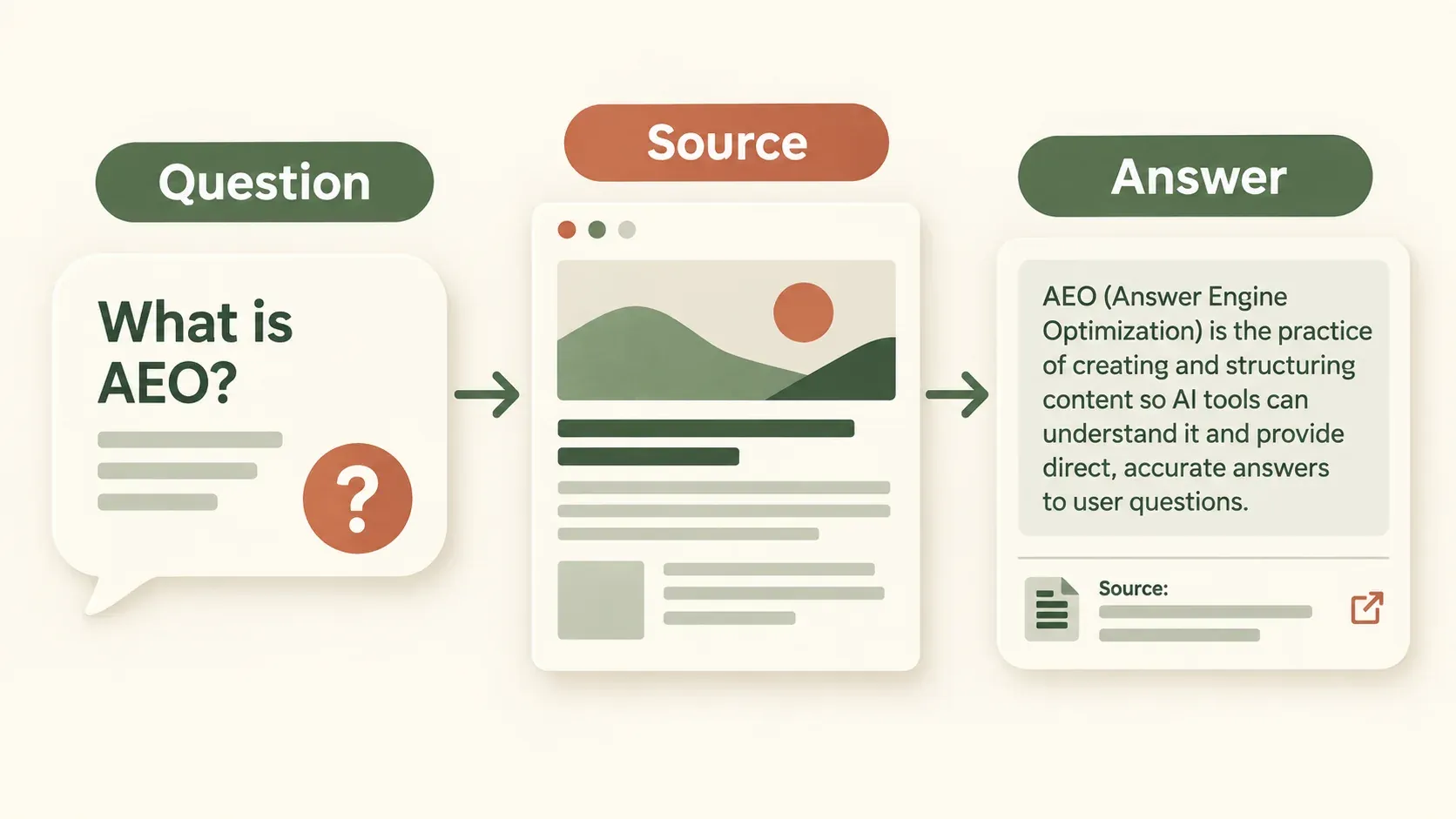
Answer engine optimisation (AEO) is the work of making useful information easier for answer systems to find, interpret and attribute. For an agency, the practical unit of work is a customer question supported by a reliable page, not a keyword or a piece of markup. AEO cannot guarantee that an engine will mention a brand or cite a particular URL, and any brief that promises otherwise is overstating what the work can do.
This guide sets out a practical sequence: pick a question the business can genuinely answer, brief the page properly, publish it so both readers and answer systems can use it, and record what happens afterwards without confusing an observation with a business result.
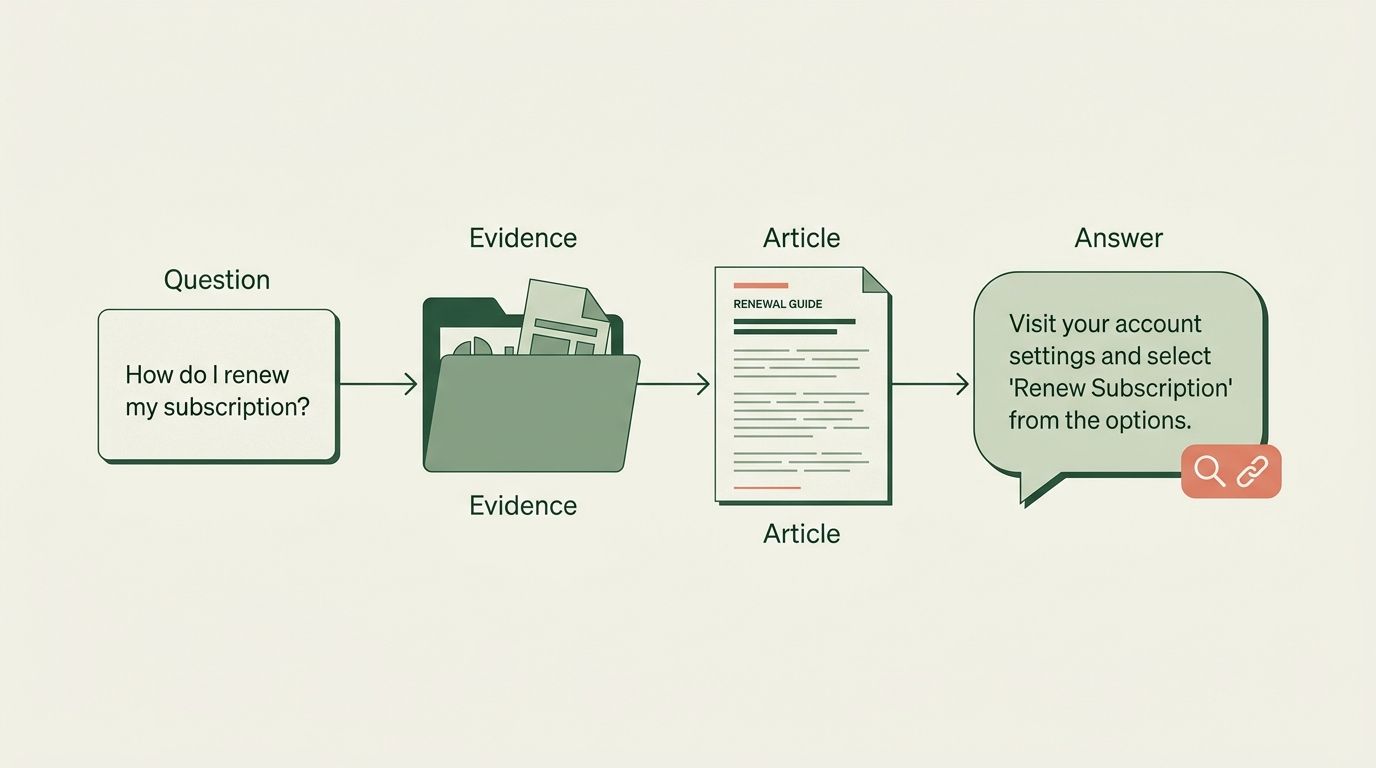
Start with a question the business can answer
Choose a question that already occurs in sales conversations, support tickets or service delivery. Before drafting anything, identify three things: the reader, the decision they are trying to make, and the evidence that actually exists inside the business to support an answer. An article assembled only from other websites cannot supply an observation the business has never made, no matter how well it is structured.
Consider a fictional inventory-software provider used purely as a worked example throughout this guide. A useful question for that business is “How should a retailer set a reorder point when supplier lead times vary?” The subject-matter expert at that fictional company might have an approved calculation, an anonymised example and a known exception to the rule. Those are legitimate inputs for an article. They are not proof of a software product’s commercial results, and they should never be written up as if they were.
A quick check before you commit to the topic
- Can someone inside the business explain the answer in their own words, without reading a competitor’s page first?
- Is there a real example, calculation or exception the team can point to, even if it needs anonymising?
- Does the question map to an actual decision a reader is trying to make, rather than a keyword someone found in a research list?
- Is there a clear boundary where the answer stops applying, and can someone name it?
If the answer to any of these is “no”, the topic is not ready for a brief yet. Go back to the business and find the missing evidence first, rather than filling the gap with generic phrasing.
A common mistake at this stage
Treating the fictional worked example, or any illustrative example like it, as if it were a real client outcome. An illustrative example is useful for planning a brief. It becomes misleading the moment it is published under a client’s name without being replaced by verified inputs and, where appropriate, the client’s own sign-off.
Build the brief before drafting
Use a short brief to force the missing details into the open before anyone starts writing. The fields below are the minimum that should be filled in, using the fictional inventory-software example purely to show what a completed row looks like.
| Brief field | What to record | Illustrative entry |
|---|---|---|
| Reader and decision | Who needs the answer, and why | A retail operations manager choosing a stock-replenishment rule |
| Main question | One question the page will resolve | How does variable lead time affect a reorder point? |
| Direct answer | A concise explanation with its assumptions | Explain the calculation and when the input data is unreliable |
| Evidence | An owned observation, approved example or primary source | A worked example reviewed by the operations specialist |
| Boundary | Where the answer stops being applicable | Seasonal demand and incomplete lead-time records |
| Next step | A relevant supporting page or action | Review the data checklist before comparing software |
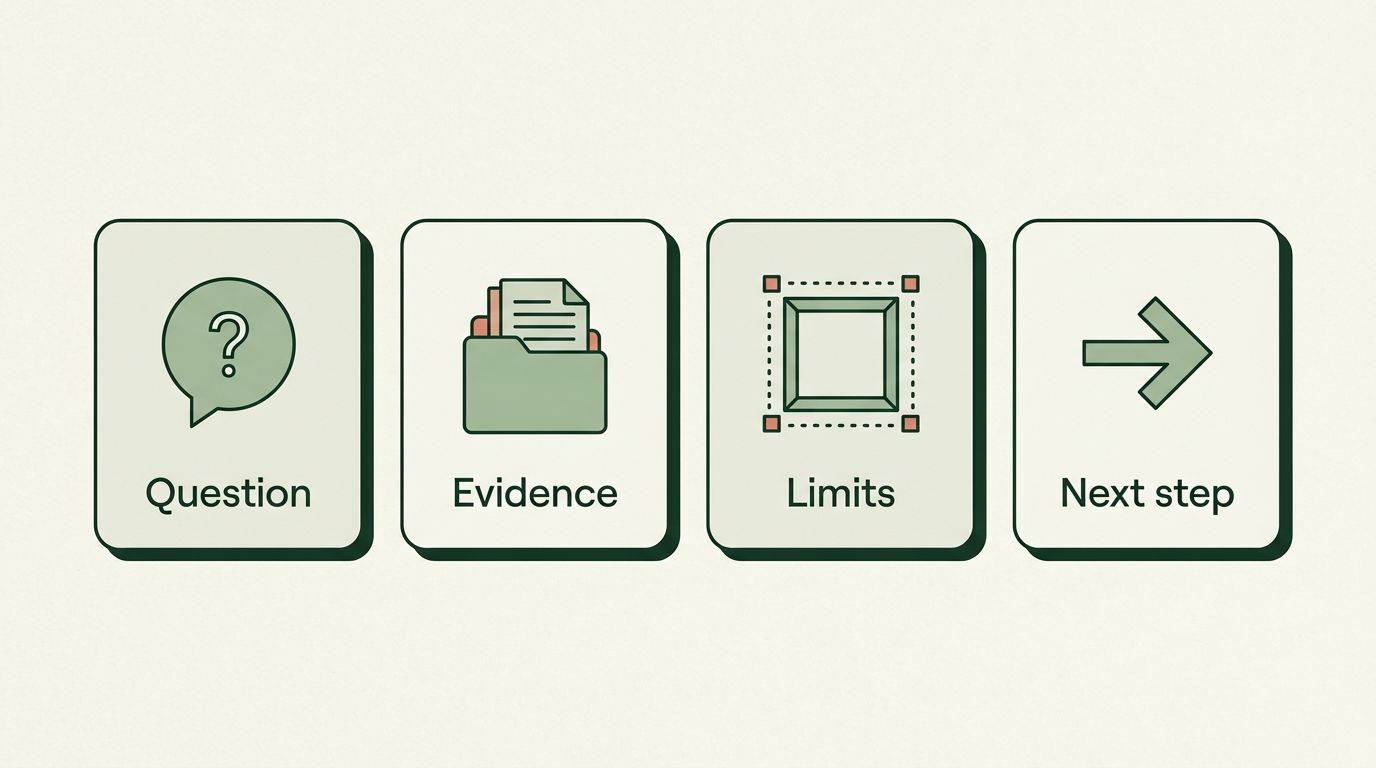
Notice that the brief separates the question from the evidence, and the evidence from the boundary. That separation matters because it stops a writer from quietly extending an answer beyond what the business can actually support. If the evidence row is empty, the boundary row usually gets skipped too, and the resulting page ends up making a claim nobody checked.
Deciding whether a topic is worth briefing at all
Before spending time on a full brief, weigh the topic against three simple criteria:
- Frequency: does this question come up often enough in real conversations to justify a dedicated page, or is it a one-off?
- Evidence availability: is there an internal expert, example or dataset that can support the answer, or would the page have to rely entirely on secondary sources?
- Decision relevance: does answering this question move a reader closer to a decision the business cares about, such as choosing a supplier rule or comparing tools?
A topic that scores well on frequency but has no supporting evidence is not ready. It is a candidate for research, an interview with a specialist, or a data-gathering exercise before it becomes a brief.
Make the answer usable as a page
Put the direct answer near the question, then explain the method, the evidence and the limitations in that order. Use headings that describe the actual sections of the page rather than generic labels, so a reader (or an answer system parsing the page) can tell what each part covers without reading the whole thing. Define specialist terms as they appear, name the organisation responsible for the claim, and link to supporting material where a reader genuinely needs it rather than as decoration. A concise opening is useful because it gives both readers and answer systems something to quote; an arbitrary word count is not the objective and should never drive the structure.
Checks to run before publishing
- Check the public page itself, not just the writing tool’s preview. A preview can look correct while the live template drops a heading level or truncates the answer.
- Confirm the body copy is readable without JavaScript rendering issues, and that every useful link actually resolves to the intended destination.
- Confirm the canonical tag points to the intended URL for that page, not to a staging address or a near-duplicate.
- Read Google’s guidance for AI features, which describes eligibility in relation to ordinary Search requirements. Special AI markup is not a shortcut to inclusion, so do not treat schema alone as the fix for a weak or unclear answer.
Common mistakes at the publishing stage
- Burying the direct answer under several paragraphs of introduction, so neither a human reader nor an answer system can find it quickly.
- Reusing a heading structure copied from a competitor’s page instead of one that reflects the business’s own evidence and boundary.
- Checking only the CMS preview and assuming the live page will match it exactly.
- Adding AI-specific markup as a substitute for fixing a page that does not actually answer the question clearly.
Measure observations separately from business results
Once a page is live, record what actually happens when it is tested against real prompts. For each check, note which prompt was tested, which engine answered, the target market, the date of the check, whether a response arrived at all, whether it mentioned the brand, and which URLs, if any, it cited. A brand mention without a source link is a different observation from a citation with one, and the two should never be logged as the same thing. Neither observation, on its own, establishes a website visit or a sale, and reporting should not imply that it does.
Decision criteria for interpreting the log
- If an engine mentions the brand but cites no URL, treat that as a visibility signal only, useful for tracking trends, not for attributing traffic.
- If an engine cites a specific URL, check whether that URL is the page the brief was written for, or a different page entirely. If it is a different page, record which source the response used without inferring why the engine selected it.
- If an engine returns a usable answer without mentioning the brand, record a brand absence. If the request fails or produces no usable answer, record an unavailable response separately. This keeps missing coverage distinct from an observed absence.
Use the AI visibility measurement method for a repeatable way of recording these checks over time. For the page-level implementation details covered above, continue with the technical review checklist, which goes into more detail on the publishing checks.
Start with a small set of well-supported answers rather than trying to cover every question at once. Review what was actually published against the original brief, not just what was intended, and keep the original evidence, examples and specialist sign-off available so the page can be revised honestly the next time the underlying facts change.